





Hello Heart Hero. You check your Apple Watch, KardiaMobile, or another ECG device because something feels off, and then a note or tracing pops up that says atrial fibrillation. Your pulse might feel uneven, your chest might feel fluttery, and your mind probably jumps straight to the worst-case scenario. That reaction is human, and it makes sense.
Rate controlled atrial fibrillation sounds technical, but the idea is simpler than the name suggests. The rhythm problem is still there, yet the heart rate is being kept in a safer, more workable range. For many people, that turns a frightening alert into something they can understand, track, and discuss with a clinician without panic.
Hello Heart Hero and What Awaits You
A lot of people first meet AF through a watch alert, not a clinic visit. One minute they're checking a step count, the next they're staring at an irregular rhythm message and wondering whether they should stop what they're doing, call someone, or wait it out. That uncertainty is often the hardest part.
The good news is that a rate-controlled rhythm is usually a managed rhythm, not a crisis by itself. The heart's upper chambers can still be fibrillating, but the lower chambers are being kept from racing out of control. That's why many people can feel surprisingly okay even when the tracing doesn't look “normal.”
A wearable ECG can show an important clue, but it can't tell the whole story on its own.
By the end of this guide, you'll know what the term means, what it looks like on a wearable ECG, and how to think about your readings in daily life. You'll also know why a heart rate that looks “fine” on a watch doesn't automatically mean the episode is harmless.
Understanding Rate Controlled Atrial Fibrillation
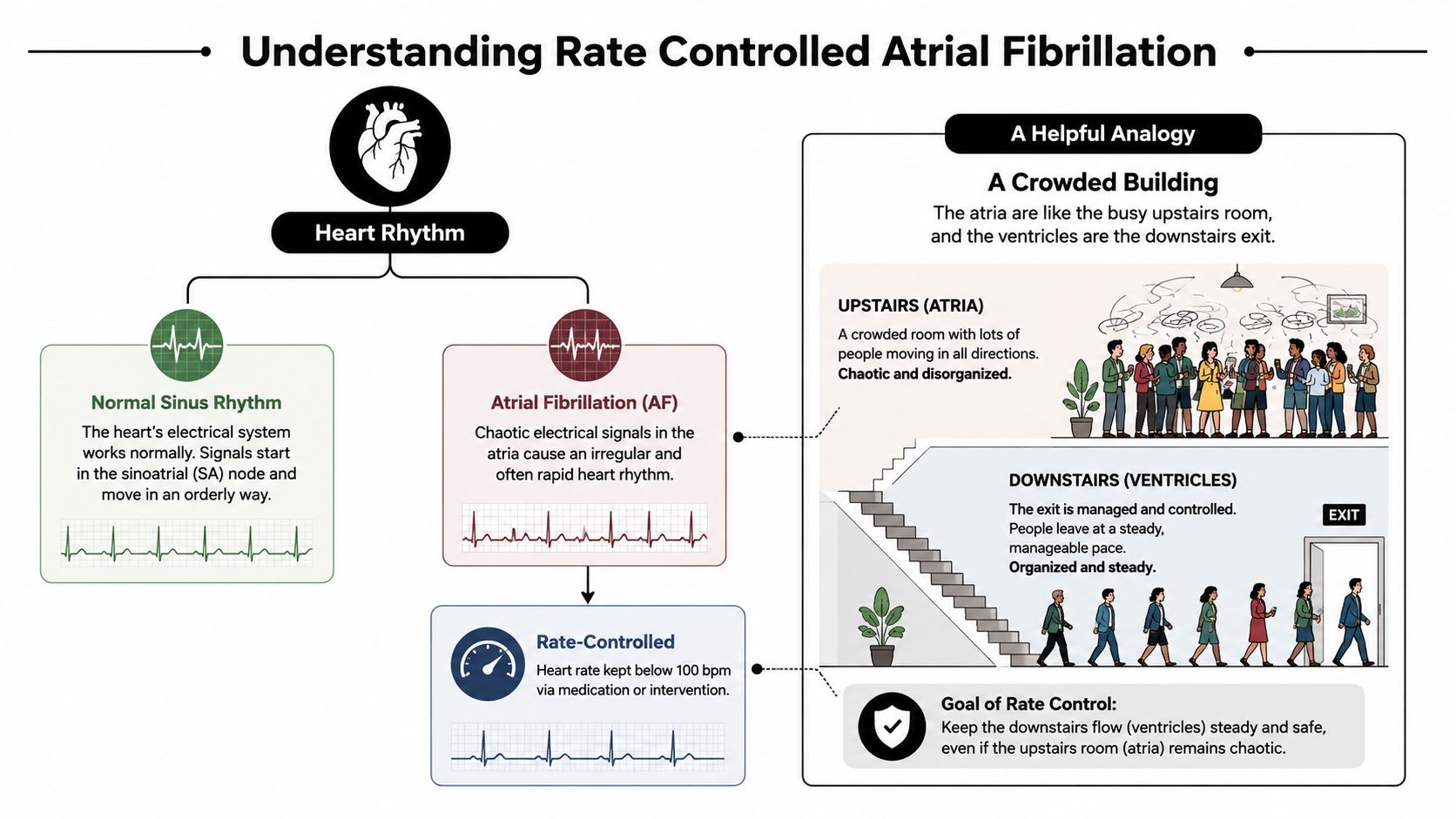
In atrial fibrillation, the upper chambers of the heart, the atria, fire in a chaotic, disorganized way. The electrical signals don't travel in the neat pattern seen in normal sinus rhythm, so the atria quiver instead of squeezing cleanly. In rate-controlled AF, treatment focuses on slowing the signals that reach the lower chambers, the ventricles, so the pulse doesn't run too fast.
A simple way to picture it
Think of a crowded building. Upstairs, people are moving around chaotically and talking over one another. Downstairs, security is still keeping the exit orderly enough that people can leave without a stampede. In AF, the atria are still chaotic, but the ventricles are being kept at a controlled pace.
That's the key point many people miss. Rate-controlled AF is not the same as normal rhythm. The atria are still fibrillating. The goal is to keep the ventricular response from becoming so fast that symptoms worsen or the heart gets strained.
Clinical practice often uses a resting target around 60 to 80 bpm, with 90 to 115 bpm during moderate exercise, although some people are managed more leniently if symptoms are controlled and left ventricular function stays preserved clinical rate-control overview. The modern lenient approach grew stronger after the RACE II trial, which used a resting goal of <110 bpm and found lenient control noninferior to strict control in permanent AF RACE II results.
What Your ECG Shows During Rate Controlled AF
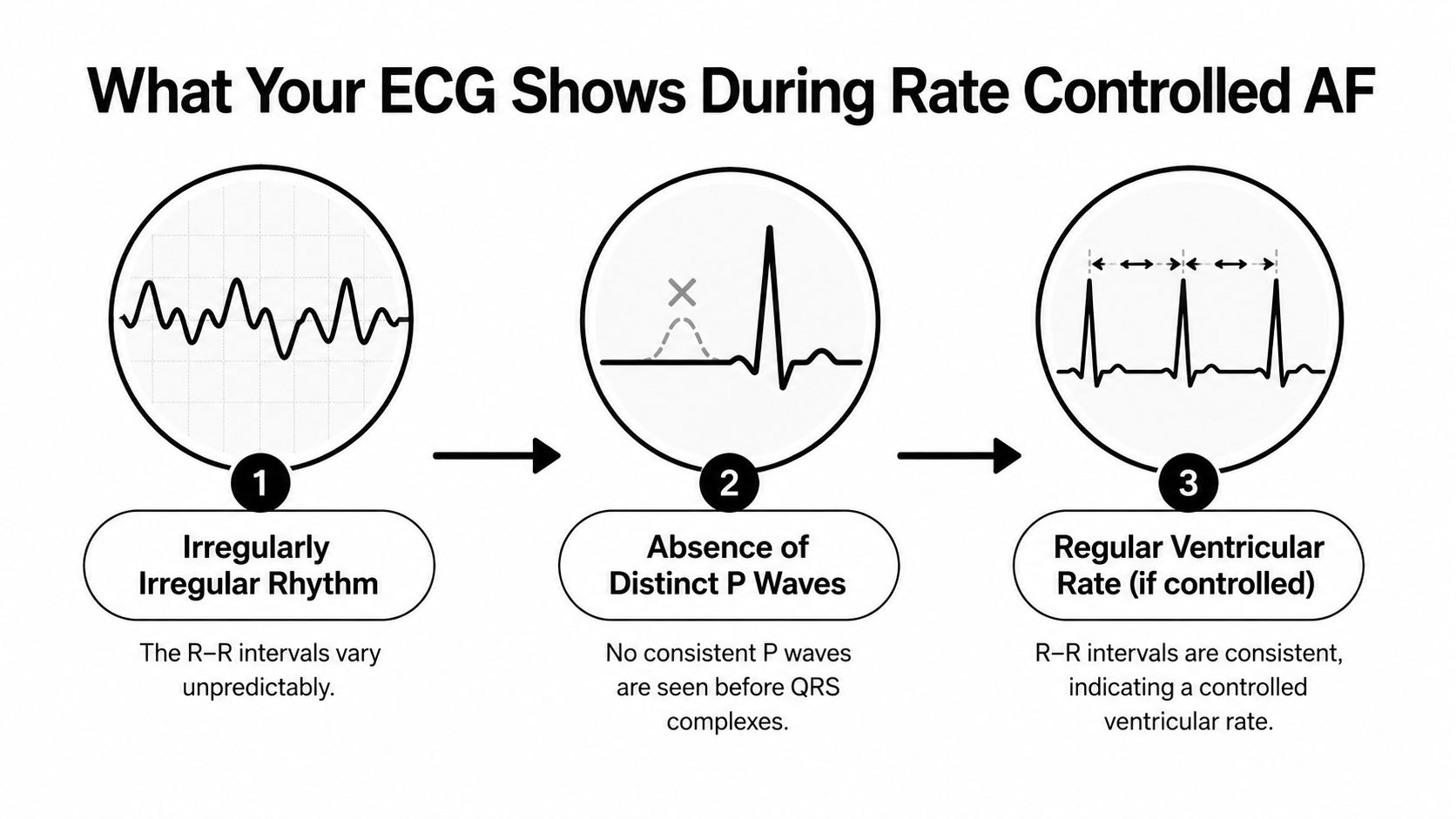
A wearable ECG helps you see the rhythm instead of just feeling it. The first clue is usually an irregularly irregular pattern, which means the spaces between beats don't repeat in a predictable way. On a watch strip, that looks uneven and a little messy, even if you're sitting still.
The three main features to look for
The tracing also usually lacks the normal P waves, which are the small bumps that represent atrial depolarization in sinus rhythm. In AF, those are replaced by fibrillatory activity, so the baseline can look wavy or indistinct. The QRS complexes may still look narrow and familiar, because the ventricles are being activated through the usual pathway.
What changes the label from “AF” to “rate controlled AF” is the ventricular rate. If the rate is being kept within a workable range, the tracing can still show AF without looking like a medical emergency. For a practical breakdown of how wearable strips are read, the article on how AF looks on your watch ECG is a useful companion, and browse ECG biomarker details can help if you want to understand interval measurements in more depth.
A few terms help you make sense of the strip:
- PR interval, the normal pause between atrial and ventricular activation, is usually not visible in AF because there isn't an organized P wave to measure.
- QRS complex still matters, because it shows how the ventricles are conducting.
- Ventricular rate is the number that tells you whether the heart is being controlled or is running too fast.
Rate Controlled Versus Uncontrolled Atrial Fibrillation
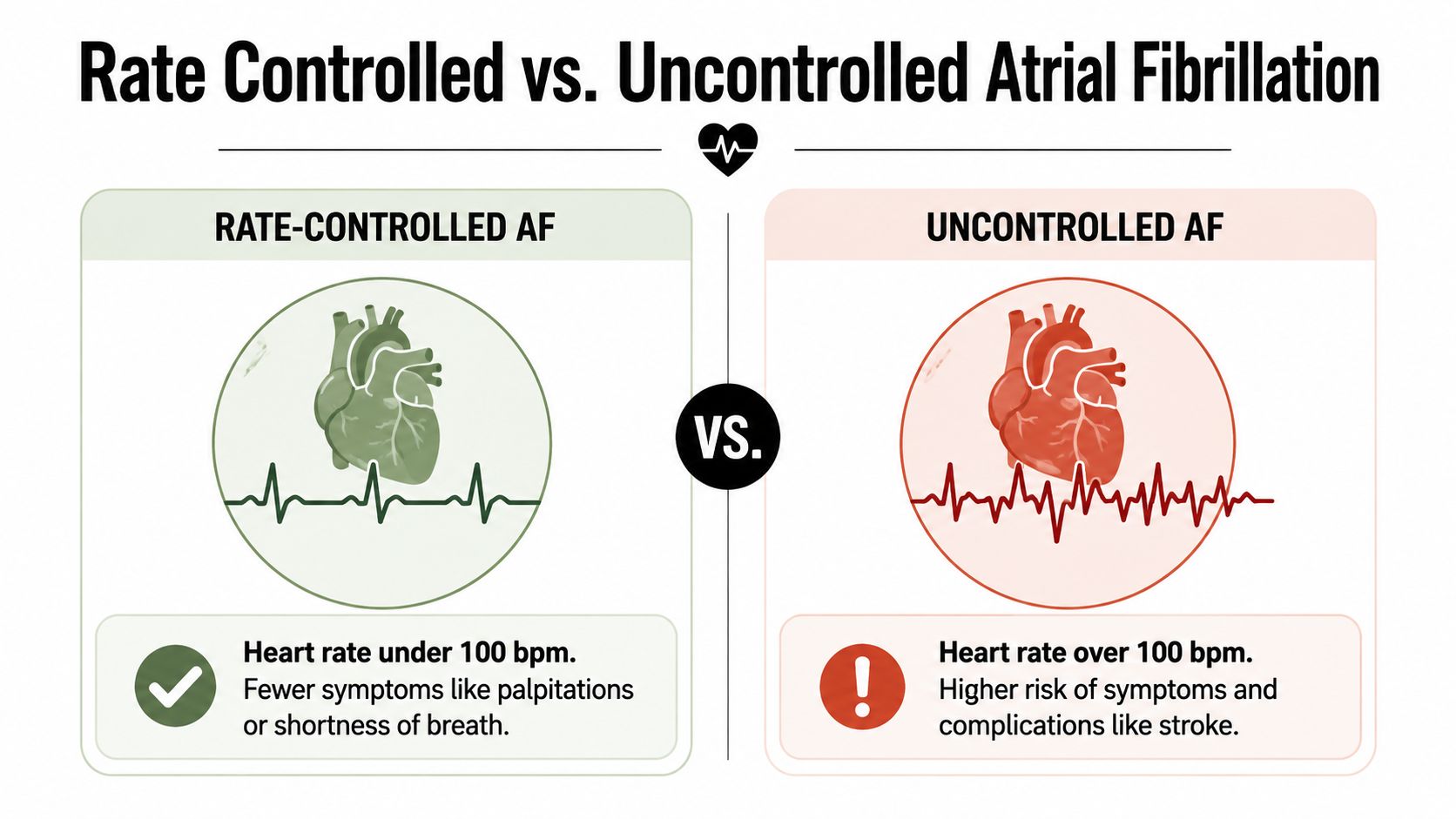
The difference comes down to how hard the ventricles are working. In both cases, the atria are in fibrillation. In one case, the lower chambers are being kept in a more efficient range. In the other, they're being driven too fast.
Rate-controlled AF often feels calmer. People may still notice palpitations or an odd pulse, but the heart isn't usually pounding at the same intensity as in faster AF. Uncontrolled AF means the ventricular response is too rapid, and that can make ordinary activity feel exhausting.
Practical rule: if the rhythm is irregular but the rate is steady enough that you can function and your clinician has said the target is acceptable, that's very different from a tracing that shows AF plus a persistently fast pulse.
The older AFFIRM trial helped make this distinction clinically important. It reported no survival advantage for rhythm control over rate control, with 356 deaths in the rhythm-control arm versus 310 deaths in the rate-control arm, and mortality rates of 23.8% and 21.3%, respectively AFFIRM trial. That history is part of why rate control became a mainstream strategy for many patients.
For a plain-language comparison of heart-rate concerns, see what counts as a dangerous heart rate with AF. The important takeaway is that rate control is management, not a cure. It aims to keep the heart working more smoothly, reduce symptoms, and lower the chance of tachycardia-related strain.
Get your ECG checked by certified experts within minutes on the Qaly app.


Recognizing Symptoms and Knowing When to Seek Help
Some people with rate-controlled AF feel almost normal. Others still notice palpitations, lower exercise tolerance, mild fatigue, or a touch of lightheadedness. Those symptoms don't always mean danger, but they do mean the heart deserves attention.
What to watch for
If your episodes are becoming more frequent, longer, or more uncomfortable, that's worth reporting. If your wearable ECG shows the heart rate drifting upward and staying up, that may mean the AF is no longer well controlled. A tracing can be a useful clue, but your symptoms matter just as much.
Seek urgent help if you have:
- Chest pain that doesn't quickly settle.
- Severe shortness of breath.
- Fainting or near-fainting.
- Confusion or new trouble thinking clearly.
- A heart rate that suddenly spikes well above your usual target and doesn't come down.
Rate control also does not erase stroke risk. AF can still carry thromboembolic risk even when the pulse looks reasonable, so anticoagulation decisions belong with a clinician who can weigh your personal risk factors and overall picture stroke prevention and follow-up in AF.
If the rhythm looks controlled but you feel worse, trust the symptom. A watch reading is helpful, but it's not a substitute for clinical judgment.
Clinical Management Options for Rate Controlled AF
A patient who sees a calm, regular-looking rate on a wearable ECG may still need treatment choices customized to how the heart is working underneath. Rate control means keeping the ventricles from speeding up too much during atrial fibrillation, usually by using medicines that slow conduction through the AV node. The main drug groups are beta-blockers, non-dihydropyridine calcium channel blockers such as diltiazem and verapamil, and digoxin rate-control drug overview.
The right medicine depends on the rest of the heart, not just the pulse on a watch screen. Verapamil and diltiazem are usually avoided in people with heart failure or reduced left ventricular ejection fraction because they can weaken contraction, while digoxin or IV amiodarone may be used when faster control is needed or systolic dysfunction limits other options acute management review. In AFFIRM, beta-blockers with or without digoxin achieved rate control in about 70% of patients, compared with 54% for calcium channel blockers with or without digoxin rate-control therapy review.
What else usually comes up
A controlled rate does not mean the whole job is done. Clinicians still weigh stroke prevention, symptom burden, and whether rhythm control would fit better in a specific case. They also look for common triggers such as infection, fluid overload, poor sleep, or stress, because AF often becomes more noticeable when the body is under strain.
If you want a plain-language summary of the common drug classes, the article on rate control medication is a useful place to start. Lifestyle changes can help too, especially better sleep, less stimulant overuse, and better handling of known triggers. They support medical treatment, but they do not replace it.
How Wearable ECG Devices Help You Monitor AF at Home
A wearable ECG can turn a vague sensation into a recording you can review later. Devices like Apple Watch, Fitbit, Samsung Galaxy Watch, KardiaMobile, and Withings can capture single-lead ECGs that show whether the rhythm looks irregular and whether the rate seems controlled. That's especially useful when symptoms come and go.
Getting a cleaner recording
Stillness matters. Rest your hands, follow the device instructions closely, and record during symptoms when you can. If the strip is noisy because you moved, repeat it later when you're calm, because motion artifact can make the tracing harder to interpret.
If you want a more structured review, some services combine wearable ECGs with human interpretation. Qaly, for example, reviews at-home and wearable ECG recordings and returns interval measurements such as PR, QRS, and QTc alongside a narrative report. That kind of review can make it easier to bring a clear summary to your clinician.

A useful habit is to save strips that match symptoms, even if they look “not too bad” at first glance. The rhythm may still matter, and the trend over time can matter just as much as one reading. If you want a device-specific walkthrough, ECG for Apple Watch is a practical reference.
Your Next Steps Toward Heart Confidence
Rate controlled atrial fibrillation means the chaotic atrial activity is still present, but the ventricles are being managed more effectively. That distinction matters because it helps explain why a person can have AF on a tracing and still feel stable enough to go about the day. It also explains why a normal-looking pulse on a wearable doesn't erase the need for follow-up.
Your readings are most useful when you treat them like a diary, not a verdict. Save the tracings, note what you were doing, and pay attention to patterns such as sleep loss, stress, dehydration, or missed medication. Those details often help a clinician make sense of the rhythm faster than a single snapshot ever could.
You're not weak for wanting reassurance, and you're not overreacting by paying attention to your heart. Learning what the strip means is a real form of self-care. Bring your recordings to your next appointment, ask direct questions, and keep tracking what your body is telling you.
Unsure if your AF looks rate controlled? Certified experts review your ECG within minutes.


